


You’d sign up for a course, watch a bunch of videos, and take a quiz—all by yourself. it was a pretty isolating experience.
But that’s totally changed now. The real magic happens when you’re part of a thriving online learning community, where you can actually connect, collaborate, and learn from your peers.
For content creators, community managers, and digital natives building these spaces in 2025, picking the right platform is everything.
It’s the difference between a ghost town and a buzzing hub of activity that actually boosts course completion rates. Let’s break down the 14 best platforms making this happen.
What Defines a Modern Online Learning Community Platform?

So what makes a platform stand out in 2025? It’s not just about hosting videos anymore. The game has completely shifted from passive content consumption to active, community-driven engagement.
Core Features of Community-First Platforms
The best online learning community platforms bake social features right into their DNA. We’re talking native discussion forums attached to specific lessons, real-time chat for those “aha!” moments, and dedicated spaces for group projects.
These aren’t afterthoughts or clunky add-ons; they’re the main event. If a platform makes you leave the course to go ask a question somewhere else, it’s already failed the vibe check.
The Shift from Passive Content to Active Engagement
Remember when online courses were basically just glorified YouTube playlists? Yeah, we’ve moved on. The modern student learning communities are all about interaction.
The most effective ones support both async (message boards, comments) and sync (live video calls, real-time chat) communication.
This mix is crucial because, let’s face it, we all have different schedules. Someone might be studying at 2 PM, while another is cracking the books at 2 AM.
Essential Tools for Student Collaboration in 2025
Looking ahead, AI is becoming a non-negotiable part of the toolkit. The top collaborative learning platforms are using AI for smart moderation (automatically flagging spam or off-topic posts) and, more importantly, for personalized peer matching.
Imagine the platform suggesting you connect with someone else who’s struggling with the same calculus problem or shares your interest in graphic design. That’s the future, and it’s already here on some platforms.
How to Evaluate an Online Learning Platform for Community Building?
With so many options out there, how do you even choose? It’s easy to get dazzled by a slick course player, but you’ve gotta dig deeper into the community specs.
5 Key Criteria for Community-Focused Selection
Here’s what I look for, honestly.
| Feature | Why It Matters | What to Look For |
|---|---|---|
| Engagement Analytics | Tracks real participation, not just logins | Dashboards showing posts, replies, and reactions |
| Cohort Creation | Builds intimacy in large communities | Easy tools to create and manage small groups |
| Content Format Support | Caters to different learning styles | Text, video, audio, and image support in discussions |
| Moderation Tools | Scales community management | Keyword flags, user roles, auto-moderation |
| Mobile Experience | Accessibility for on-the-go students | A fully-featured native mobile app |
14 Best Online Learning Community Platforms for 2025
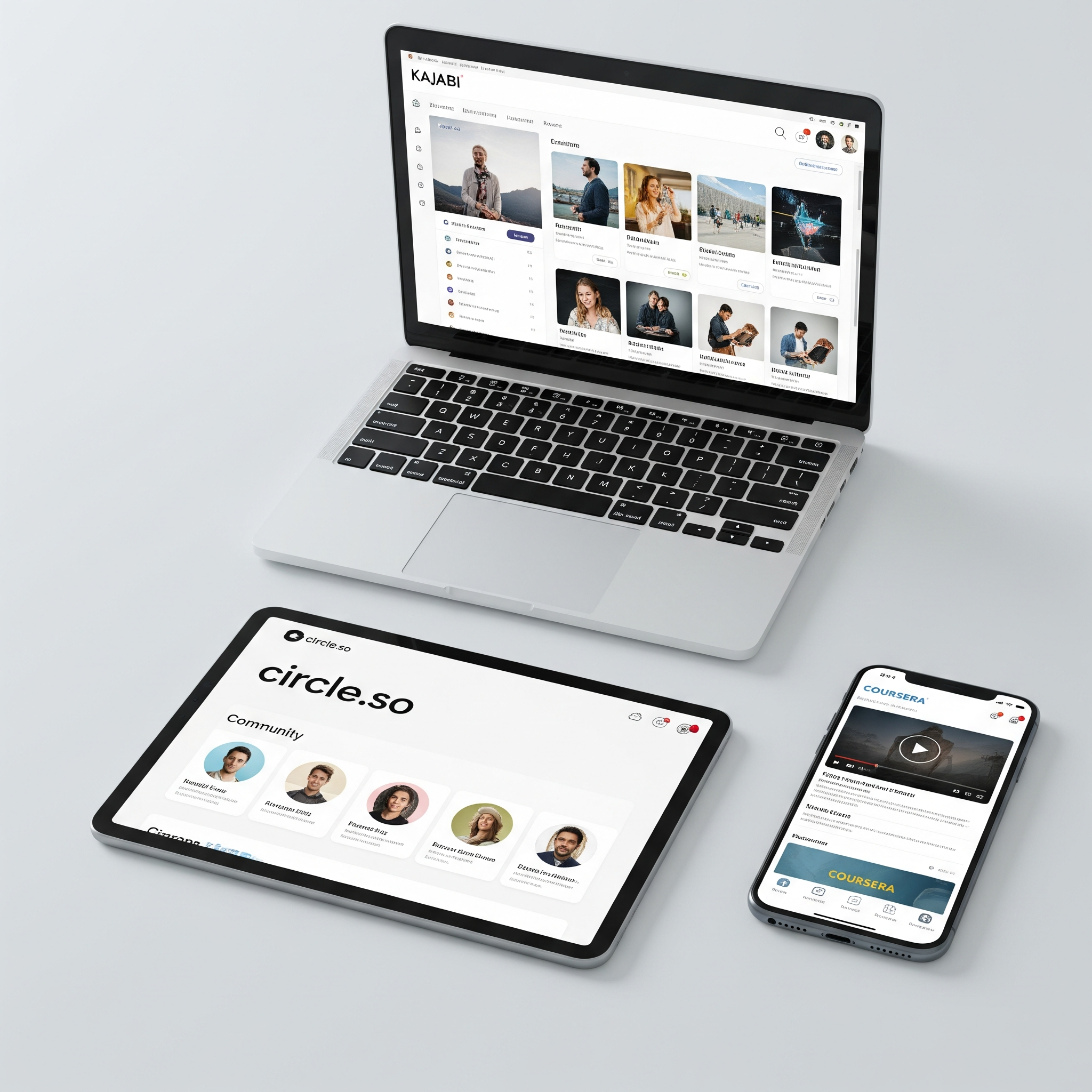
After testing a ton of options, these are the 14 platforms that are genuinely killing it in the community space right now.
Platform 1: Circle.so
Circle.so is lowkey my top pick for creators who want a seamless experience. Its biggest win is how it blends course hosting and community into one clean space.
Your students don’t have to jump between different tabs or apps—the discussions happen right next to the lesson content. It reduces friction big time, which is everything for keeping people engaged.
Platform 2: Kajabi
If you’re serious about monetizing your knowledge, Kajabi is a powerhouse. It’s not just a community platform; it’s your entire business engine.
You get website building, email marketing, payment processing, and community features all under one roof. It’s a bigger investment, but it saves you from the nightmare of trying to stitch ten different tools together.
Platform 3: Mighty Networks
Mighty Networks is all about bringing people together around a shared passion, and it shows. The vibe is less “course” and more “clubhouse.”
Their event hosting and content organization tools are top-tier, making it perfect for communities that are about ongoing connection rather than just finishing a single course.
Platform 4: Discord
Don’t sleep on Discord. While it wasn’t built for education, it’s become a go-to for students, especially in tech and gaming niches. It’s free, wildly customizable, and your audience probably already knows how to use it.
The real-time text and voice channels are perfect for study groups and quick help. For a deep dive on customization, the official Discord API documentation for educators is a goldmine. Just know it lacks native course tracking, so it often works best as a supplement.
Platform 5: Thinkific
Thinkific has long been a favorite for building beautiful courses, and they’ve been steadily adding community features.
You can build your course first and then layer in a community either through deep integrations with Circle or their own native “Communities” feature. It’s a great “start simple and scale up” option.
| Platform | Best For | Community Vibe | Starting Price (approx.) |
|---|---|---|---|
| Circle.so | Seamless integration | Course-centric forum | $39/month |
| Kajabi | Monetizing expertise | Professional network | $119/month |
| Mighty Networks | Niche interests | Passion-based club | $33/month |
| Discord | Informal, real-time chat | Live hangout | Free |
| Thinkific | Course-first approach | Supplemental space | $36/month |
Platforms for Academic and Formal Education

If you’re looking for something with more academic rigor and potential credit, these platforms partner with legit universities.
Platform 6: Coursera
Coursera’s whole thing is its partnerships with schools like Stanford and Yale. This is where you go for professional certificates and even full online degrees.
The community aspect often comes in the form of peer-graded assignments and discussion groups for each course, connecting you with other career-focused students.
Platform 7: EdX
Founded by Harvard and MIT, edX keeps a non-profit, academic focus. They excel at cohort-based learning, where you move through a course with the same group of people.
This structure is fantastic for building a sense of camaraderie and accountability, much like a traditional classroom.
Platform 8: FutureLearn
FutureLearn literally designed its platform around “social learning.” The interface encourages you to comment on each step of the course and reply to others.
It feels less like a solo mission and more like a collective journey, which is perfect for subjects that benefit from discussion and debate.
Niche and Skill-Based Community Platforms

Not every community is for getting a degree. Sometimes you just want to learn a specific skill with like-minded people.
Platform 9: Skillshare
Skillshare is a personal favorite for creative skills. Its project-based format is a natural community-builder. You take a class on illustration, post your project, and then give and get feedback from others.
It’s this cycle of sharing that makes it feel so collaborative and supportive.
Platform 10: Udemy
Udemy is the massive marketplace for courses on everything from Excel to yoga. The community here is more contained within each course’s Q&A section.
It’s a micro-community where you can ask the instructor and other students for help on specific lectures. It’s not a sprawling network, but it’s incredibly effective for getting unstuck.
Platform 11: Teachable
Similar to Thinkific, Teachable gives creators powerful tools to build their own branded school.
While its native community features are still developing, it integrates beautifully with community platforms. It empowers you to build a loyal tribe around your personal brand.
Emerging and AI-Powered Platforms for 2025

These are the newcomers and innovators that are pushing the boundaries of what a learning community can be.
Platform 12: Disco
Disco is all in on AI. It uses machine learning to personalize the experience, suggesting relevant peer connections and content based on your activity. It’s like having a community manager that never sleeps, constantly working to make your network stronger and more relevant. This is a huge leap for effective course creation with AI.
Platform 13: Skool
Skool uses gamification—think points, leaderboards, and rewards—to motivate participation. It turns learning into a more game-like experience, which can be incredibly effective for certain audiences.
Platform 14: Geneva
Geneva feels like a hybrid of Slack, Discord, and a forum. It organizes conversations into thematic ‘rooms’ (text, voice, video) with a super clean, app-like interface.
It’s incredibly intuitive and appeals to a younger, mobile-first audience that wants a modern communication tool.
Comparison Table: Platform Features, Pricing, and Best Use Cases
Let’s put it all side-by-side. This table cuts through the marketing speak and shows you what each platform actually offers.
| Platform | Pricing Model | Core Community Features | Ideal For |
|---|---|---|---|
| Circle.so | From $39/mo | Spaces, Live Streams, Member Directory | Creators who want courses + community in one place |
| Kajabi | From $119/mo | Communities, Challenges, Live Events | Entrepreneurs building a full-fledged business |
| Mighty Networks | From $33/mo | Subgroups, Events, Content Batching | Niche interest communities and memberships |
| Discord | Free (Paid Nitro) | Text/Voice Channels, Roles, Bots | Informal student groups, real-time collaboration |
| Thinkific | From $36/mo | Communities (add-on), Course Q&A | Course-first creators adding community later |
| Coursera | Per course/subscription | Peer Review, Discussion Forums | Students seeking certificates & degrees |
| edX | Free to audit | Cohort Discussions, Program Tracks | Academic learners in a structured environment |
| FutureLearn | Subscription | Step-by-step Comments, Social Learning | Learners who thrive on discussion |
| Skillshare | Subscription | Project Sharing, Class Projects | Creative skill-building and feedback |
| Udemy | Per course | Q&A within courses | Solving specific problems in a course |
| Teachable | From $39/mo | Integrated Commenting, Coaching | Building a branded student base |
| Disco | Contact for pricing | AI Matching, Smart Segmentation | AI-powered, personalized communities |
| Skool | $99/mo | Gamification, Leaderboards | Communities motivated by game mechanics |
| Geneva | Free (Premium coming) | Home & Rooms, Mixed Media Chat | Modern, mobile-friendly group communication |
Strategies for Building Engagement in Your Online Learning Community

You can have the best platform in the world, but if you don’t foster engagement, it’ll be a ghost town. Here’s how to make it pop.
Creating a Welcoming Onboarding Process for New Students
First impressions are everything. Don’t just dump new members into a chaotic main feed. Create a structured onboarding sequence.
This could be a welcome email series, a pinned “Start Here” post, or even a short video from you. Introduce them to community norms, highlight some key members to follow, and give them a simple, low-stakes first task (like introducing themselves in a specific thread).
Designing Activities that Prompt Discussion and Collaboration
Engagement doesn’t happen by accident; you have to design for it. Schedule weekly live Q&A sessions. Create challenge-based assignments that require peer feedback.
Set up a “mastermind” system where small groups meet regularly. These routine interaction points give people a reason to keep coming back beyond just consuming content.
Leveraging User-Generated Content to Foster Ownership
The most vibrant communities aren’t built by the host alone—they’re built by the members. Feature outstanding student work. Create a “Member of the Month” spotlight.
Invite active students to lead an AMA (Ask Me Anything) or host a study session. When members feel ownership, they become your best advocates and community builders.
Frequently Asked Questions
What is the most important feature to look for in an online learning community platform?
Seamless integration. The community should be built directly into the learning path, with discussions attached to lessons and notifications within the platform.
Are free platforms like Discord sufficient for a structured educational community?
For informal study groups, yes. For formal, structured courses, no. They lack built-in progress tracking, assignments, and often require heavy manual moderation.
How can I encourage shy or reluctant students to participate in the community?
Use low-pressure options like polls, reactions, and icebreakers. Implement small breakout groups or a buddy system. Recognize all forms of contribution.
What is the typical cost range for a robust online learning community platform?
Dedicated platforms start at $30-$50/month. All-in-one solutions begin around $120-$150/month. Enterprise-level platforms can cost hundreds or thousands per month.
How does AI enhance online learning communities?
AI automates moderation, identifies struggling students, and personalizes the experience by recommending relevant content and connections.
Can an online learning community replace a traditional classroom?
For knowledge-based subjects, yes, if well-designed. It offers greater accessibility and global connections but may not suit hands-on practical skills requiring in-person work.
